Phuket for Architecture Lovers: The Old Town and What Else Is Worth the Detour
Updated September 17, 2026 · 8 min read
Phuket is not sold as an architectural destination, and most visitors leave without seeing the one thing on the island that genuinely is. The old town on the east coast holds a protected quarter of Sino-Portuguese shophouses – a building type that exists in only a handful of places in the world, and here it comes with a clear economic story attached.
This guide is for the traveller who would rather spend an afternoon looking at buildings than a day on a boat. It also says honestly how much there is, because the answer is less than the photographs suggest.
What Sino-Portuguese actually means
The style came with tin. From the nineteenth century, Hokkien Chinese migrants arrived on Phuket for the tin-mining trade, and the merchant families who prospered built in a hybrid manner: Chinese shophouse plans – narrow frontage, deep interior, courtyards and airwells to move air and light through a long building in a hot climate – dressed in European neoclassical and colonial detail. Stucco pilasters, shuttered upper windows, moulded cornices, over a plan no European would have drawn.
The detail to look for at street level is the five footway: the arcaded walkway running in front of the ground-floor shops, continuous from building to building, so you can walk a whole street under cover. It is a rain-and-sun device, and it is also the reason the old town is walkable at two in the afternoon when nothing else on the island is.
The names tell the same story. Dibuk Road takes its name from the Thai word for tin.
The seven streets
The protected zone is small and specific. Seven streets form the conservation area:
Thalang · Dibuk · Krabi · Phang Nga · Yaowarat · Ranong · Soi Romanee
Each has a different character, and knowing which is which saves you from walking the same block twice:
- Thalang Road – the restored showpiece. The best-kept frontages, and now also the cafés and souvenir shops. On Sundays it closes to traffic from about 15:00 and becomes the Walking Street market from 16:00 to 22:00, which hides the architecture behind stalls.
- Soi Romanee – the short lane connecting Dibuk and Thalang, and the most photographed row on the island. Colour-restored, narrow, and busy with photographers in the good light.
- Dibuk Road – the one to walk if you want the conservation zone as a working street rather than a restored one: ordinary businesses, less intervention, more of the original texture.
- Krabi Road – where the museum is, and where the larger merchant mansions sit rather than terraces.
- Phang Nga, Yaowarat and Ranong – the connective tissue, with individual buildings worth the detour rather than continuous runs.
You can walk all seven in an afternoon. That is both the appeal and the limitation.
Start at the Thai Hua Museum
If you do one paid thing in the old town, do this one, and do it first.
The museum occupies a 1934 Sino-Portuguese mansion on Krabi Road that was built as the island’s first Chinese-language school. It is therefore both the exhibit and the explanation: thirteen themed rooms over two floors covering the Hokkien migration, the tin trade and the families who built the streets outside, with photographs, artefacts and original immigration papers.
- Open 09:00 to 17:00, closed Mondays
- Entry 200 THB, plus 200 THB for a photo pass if you want to photograph the interior
- Allow about an hour
An hour there turns the rest of the walk from a pretty street into a legible one. The reverse order works much less well.
The religious buildings, and an honest distinction
Two sites appear on every city tour and both are worth seeing, but only one of them is old.
Wat Chalong is the island’s largest and busiest temple: open daily 07:00 to 17:00, free, shoulders and knees covered. The grand chedi and the ordination hall are the standard stops.
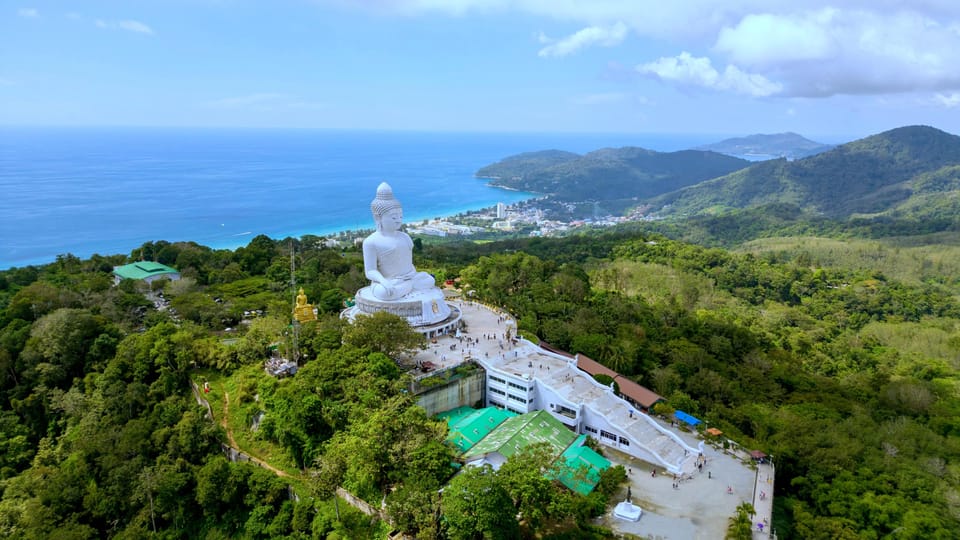
The Big Buddha on Nakkerd Hill is a contemporary monument, not a historic one – it is a modern devotional project on a hilltop, and its interest is the scale and the setting rather than the age. It is also the stop with a complicated present. The site closed after a rain-triggered landslide below it on 23 August 2024 killed 13 people and injured 19 in Kata. It reopened for three days on 1 January 2026, closed again, and reopened properly on 3 March 2026 under the official name Wat Kittisangharam (Big Buddha), operating 09:00 to 18:00 daily under 25 conditions set by the forestry department covering its use of reserve forest land. Entry is free. A class action by affected residents remains before the Phuket Provincial Court.
Given that history, if the Big Buddha is why you are booking a particular tour, confirm the stop with the operator for your date.
Getting there, and which tours pass through
The old town is on the east coast; most hotels are on the west, about 45 minutes from Patong without traffic. Your options:
| Option | From | Time in the old town |
|---|---|---|
| Phuket City Highlights: Big Buddha, Wat Chalong & Old Town | €18.62 | Part of a 5-hour circuit |
| Old Town Half-Day Sightseeing with Local Guide | €18.65 | Part of a 7-hour circuit |
| Big Buddha, Old Town & Discovery City Tour | €19.98 | Part of a 7-hour circuit |
| Taxi or app ride, self-guided | Fare only | As long as you want |
Note the pattern: the cheap tours are island circuits with an old town stop, usually forty minutes to an hour. That is enough for Thalang Road and Soi Romanee and nothing else. For an architecture-led visit the self-guided route is better, and our guided walk or on your own comparison works through the trade-off properly. Prices come from our inventory on 17 September 2026 and move; the booking page is the authority.
If you want to go deeper than looking
Three listings put you inside the culture rather than in front of it, all of them small operations with few reviews – read the descriptions rather than the scores:
- Custom Perfume Workshop at Phuket Old Town – from €33.69, 2 hours, 4.9 stars from 15 reviews
- Peranakan Cooking Class with Heritage Recipes – from €70.51, 4 hours, one review so far
- Old Town Food Tour – from €34.32, 6 hours, 4.7 stars from 7 reviews
“Peranakan” is the term for the Straits Chinese communities of the region, the same culture that produced the buildings – so a Peranakan kitchen is a reasonable second door into the same subject.
The honest caveat
The conservation zone is seven streets. It is not Penang and it is not Malacca, and a visitor who has seen those will find Phuket’s version compact and heavily caféd along Thalang Road. If you have a single free day and architecture is a strong interest rather than the only one, half a day in the old town plus a boat day is the better use of Phuket than a full day of buildings.
The other side of that judgement is that this is a living district, not a heritage park: people live behind the frontages, and the working streets are working streets. Photograph the buildings freely, ask before photographing people, and if you want the light rather than the crowds, see our guide to photographing Phuket.
For what else the island offers against a day in town, start with what to see in Phuket; the guided options are on the Phuket Old Town tours page.